Manufacturing Process
Precision Manufacturing
for Industrial Packaging.
Integrated production lines for stone paper and PP woven bags, engineered for consistency, traceability, and reliable output quality.
Overview
Two production lines, one quality standard.
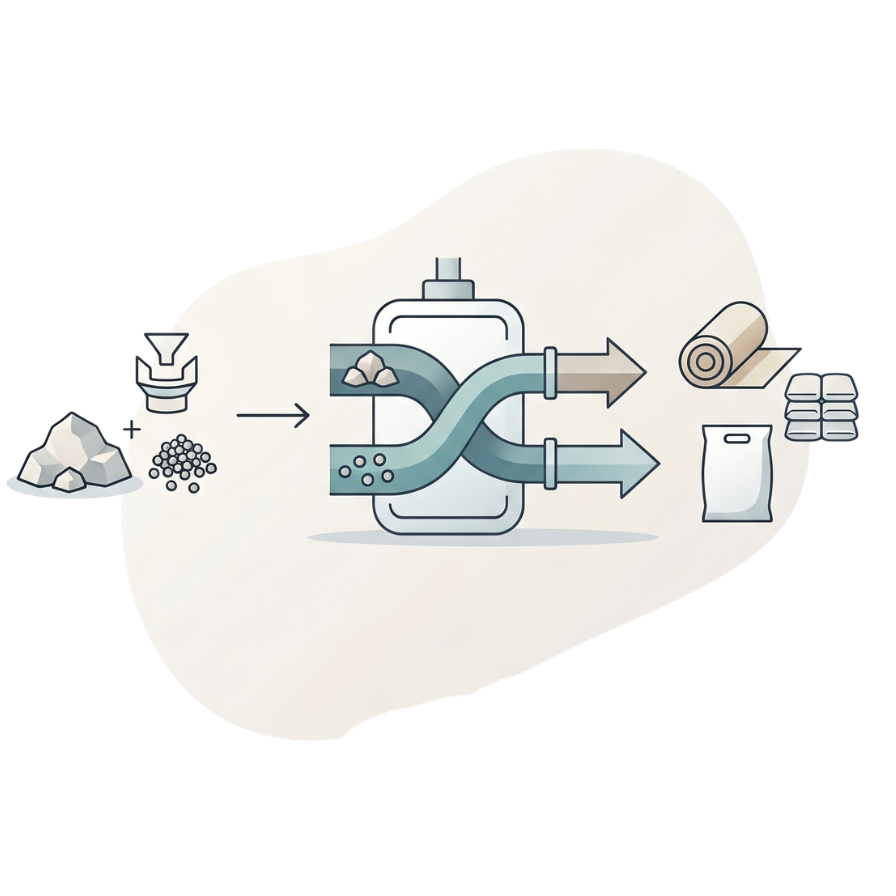
Our Luckau facility operates integrated production lines for both stone paper bags and PP woven bags. Each line is configured for high-volume industrial output with German engineering standards applied to every stage of the manufacturing process.
Stone paper production uses a mineral-based extrusion process that consumes virtually no water and requires no bleaching chemicals. PP woven bag manufacturing follows a weaving, converting, and printing workflow optimized for consistency and rapid turnaround.
24,000
m² facility
70 km
from Berlin
2
production lines
100%
German engineering
Product Demonstration
See our stone paper quality firsthand.
A demonstration of stone paper\u2019s surface quality, writing performance, and material properties directly from our Luckau facility.
Product Demo
See how our stone paper performs. Write with pen and experience the difference.
Stone Paper Production
From raw limestone to finished packaging material.
Limestone Sourcing
Raw calcium carbonate is sourced from certified European quarries. Only high-purity limestone (CaCO₃ ≥ 98%) is accepted into the production line, ensuring consistent material properties.
Grinding & Micronization
The limestone is crushed and milled into ultra-fine powder, typically 1-3 microns. Uniform particle size is critical for the material’s smoothness, printability, and tensile performance.
Compounding with HDPE
The mineral powder is blended with 18-20% food-grade HDPE resin and processing aids. The HDPE acts as a binder. No bleaches, acids, solvents, or optical brighteners are used.
Extrusion
The compound is melted and extruded under precise thermal control into a continuous film, producing uniform thickness and opacity without water consumption.
Calendering & Surface Treatment
The film passes through heated calender rolls, setting its final thickness, density, and surface finish. Surface treatment optimizes the material for industrial printing compatibility.
Quality Control & Packaging
Final rolls are slit, sheeted, and tested for whiteness, basis weight, tensile strength, and water resistance. Certified batches are palletized and shipped from our Luckau facility.
PP Woven Bag Production
From polypropylene resin to finished industrial bags.
Polypropylene Extrusion
Virgin polypropylene resin is extruded into flat yarn tapes with controlled denier weight and tenacity. UV stabilizers are added at this stage for outdoor-grade products.
Weaving
Circular or flat looms weave the PP tapes into a fabric tube or flat sheet at specified mesh density. The woven structure distributes load stress evenly across the bag surface.
Coating & Lamination
Optional PE inner coating for fine powder containment or BOPP lamination for enhanced moisture barrier and high-quality graphics. Uncoated options for breathable applications.
Printing
Flexographic printing in up to 8 colors for branding, product information, and regulatory markings. Rotogravure printing available for high-detail photographic reproduction.
Cutting & Sewing
Automated cutting to specified dimensions followed by industrial sewing for seam reinforcement. Block bottom, open mouth, and valve configurations are formed at this stage.
Quality Control & Dispatch
Each batch is tested for load capacity, seam strength, dimensional accuracy, and print quality. Certified batches are bundled, palletized, and shipped to client specifications.

Quality Assurance
Every batch is tested. Every shipment is certified.
We apply German industrial quality standards across every production run, measuring tear strength, load capacity, moisture resistance, dimensional accuracy, and print quality before release. Each certified batch is fully traceable from raw material supplier to delivered pallet.
Visit Our Facility
Want to see the production process in person?
Qualified B2B partners can arrange a guided tour of our Luckau facility. Contact us to coordinate a visit with our production team.